
Stainless Steel Jewelry: Materials and Finishing Options
Two stainless grades carry most jewelry production, and the choice between them is a corrosion question before it is a design one. 316L contains 2–3% molybdenum, the addition that lets a PVD-coated piece survive showers and swimming; 304 is water-resistant for daily wear and is normally vacuum-plated for volume ranges. Both are nickel- and lead-safe, and both sit under the same published MOQ of 100+ pieces per design.

Key takeaways
- 316L carries 2–3% molybdenum; 304 does not, which is why the swim-proof claim attaches to one grade.
- Four plating colours are published — 14K, 18K and 24K gold plus rhodium — and each is a separate coating route.
- Stainless MOQ is 100+ pieces per design, twice the 50-piece minimum for 925 sterling silver.
- Final QC covers 100% of pieces, so a surface defect is caught before packing rather than by the customer.
What separates 304 from 316L
The gap between the grades is small on a spec sheet and large in a bathroom. 316L is an austenitic stainless with 2–3% molybdenum in the alloy. Molybdenum raises resistance to chloride pitting, and chloride arrives with soap, sweat, pool water and sea water. That is the metallurgical reason a 316L piece can be sold as shower-safe and swim-proof while a 304 piece is described as water-resistant for daily wear.
304 remains a sensible material for the right range. It is nickel- and lead-safe, takes vacuum plating, and holds shape through repeated wear. Where the customer removes a bracelet before swimming, 304 does the job at a lower alloy cost. The distinction is use case, not a quality tier, and a buyer who frames it that way avoids paying for corrosion resistance nobody asked for.
Hypoallergenic wording follows the same line. 316L is described as medical-grade and hypoallergenic, a reputation it earned in surgical instruments and body piercing. A brand selling to a nickel-sensitive audience should treat that as a purchase-order specification rather than a copy line, and ask the factory to confirm the grade against the mill certificate.
Compliance sits across both grades. TTT Jewelry states REACH compliance for its metals, free of lead, cadmium and nickel, and plating that meets REACH and CA Prop 65. ISO 9001:2015 is the framework that keeps a grade claim traceable from incoming metal to packed order.
Finishing options and where they sit
Finishing is where a stainless programme gains its colour, its hand feel and most of its cost spread. Six customisation options are published, and three of them change the visible surface: plating and finishes, stones and accents, and custom logo and hallmarks.
PVD vacuum plating is the stainless route. The coating is deposited inside a vacuum chamber as a thin ceramic-metal layer rather than built up electrochemically in a tank. It bonds evenly to 316L, holds colour over a brushed or mirror face, and does not depend on current reaching every recess of a complex casting.
Electroplating is the route for silver and brass, where multi-layer 14K, 18K or 24K gold and rhodium are applied in solution. Anti-tarnish e-coating is offered on silver and brass to slow the darkening that sulphur in air causes. Stainless skips that coat, which removes a process step from the route.
Underneath the coating, the surface is its own specification. A high-gloss polish and a brushed or textured face read differently in the same gold tone, and the decision is locked before plating because the deposit copies the topography below it.
| Finish | How it is applied | Base metal | Wear context it suits |
|---|---|---|---|
| PVD vacuum plating | Vacuum deposition | 316L, 304 | Colour worn into showers and pools |
| Multi-layer gold plate | Electrolytic tank | Silver, brass | Warm tone on dress and gift pieces |
| Rhodium plate | Electrolytic tank | Silver, brass | White tone with a hard surface |
| Anti-tarnish e-coating | Dip and cure | Silver, brass | Storage and display between wears |
| Brushed or textured art | Mechanical | All three | Matte contrast on flat or curved faces |
| High-gloss polish | Mechanical | All three | Mirror face under a clear or coloured plate |
How the finish is built on the bench
The published factory flow has eight steps, and three of them are finishing: polishing, surface art and electroplating. Reading the sequence in order explains why a coating fault is usually a preparation fault.
Concept design comes first, hand-drawn and in CAD. Prototyping follows through a mould or 3D printing. Sprue cutting removes the feed channels left by casting. Polishing then brings the raw surface up to a high gloss, and surface art adds brushing or texture where the design asks for it. Only after those benches does a piece enter plating.
The order matters because a coating is thin. A pit, a file mark or a polishing smear left on the metal telegraphs through a gold layer, and extra plate does not hide it. The inspector sees it at final QC, which is stated as 100%: every piece, not a sample pulled from a tray.
Two consequences for a buyer follow. A finish change made late in development costs a fresh sample round, and sampling is published at 25–30 days. A mixed order that asks for gloss on one design and brushed on another doubles the surface-art handling even when the plating colour is identical.
Specifying grade and finish together
Most specification errors on stainless steel come from treating material and finish as independent choices. They interact at four points: exposure, colour, marking and quantity.
Start with exposure. A piece worn in water needs 316L with PVD. A piece worn to a desk needs 304 with vacuum plating and a care card in the box. Writing the intended wear context into the brief settles the grade faster than debating alloy chemistry in an email thread.
Then colour. Gold tone on stainless comes from the PVD target, not from a gold tank, so the shade is set by the coating recipe. Where the same collection includes silver and brass, those pieces reach a comparable tone through electroplating, and the two routes should be sampled side by side before approval rather than matched on a screen.
Then marking. Laser engraving of a hallmark is a published option, with S925, 316L and 18KGP given as examples. The mark has to match the metal underneath, because a 316L stamp on plated brass is a compliance problem, not a labelling preference.
Route matters too. A buyer still deciding whether design work sits on their side or the factory's can read the OEM/ODM jewelry manufacturer comparison first, since the two models differ in who owns the CAD and the mould even when material and finish are identical.
Then quantity. A buyer planning four designs is committing at least 4 × 100 = 400 units before the first reorder, and that figure belongs in the brief before CAD starts. The manufacturer's own page at https://www.tttjewelry.com/stainless-steel-jewelry-manufacturer/ sets the grades, finishes and eight-step flow beside each other, which is the quickest way to see how the options stack.
Worked example
Take a four-design stainless capsule. At the published 100+ minimum, the floor is 4 × 100 = 400 units. The same four designs in 925 sterling silver would start at 4 × 50 = 200 units, half the commitment, because the silver minimum is 50 per design. In artisan eco-brass the figure would be 4 × 100 = 400, matching stainless.
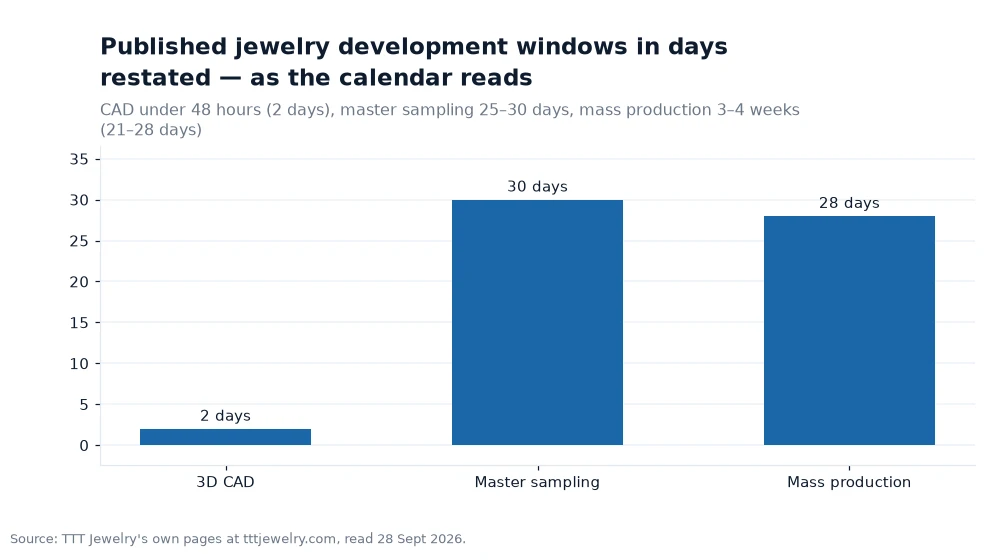
Now the calendar. CAD at under 48 hours is 2 days. Master sampling runs 25–30 days and mass production 3–4 weeks, or 21–28 days. A single round therefore costs 2 + 25 + 21 = 48 days when both windows close early, or 2 + 30 + 28 = 60 days when they run long — seven to nine weeks either way.
CAD is a thin slice of that. At 2 days inside a 48–60 day programme it accounts for 2/60 = 3.3% to 2/48 = 4.2% of the schedule. A wrong finish choice, by contrast, adds a whole sample round: a 48-day plan becomes 48 + 25 = 73 days, and a 60-day plan becomes 60 + 30 = 90 days.
Frequently asked questions
Is 304 stainless steel safe for a bracelet worn every day?
Yes. 304 is nickel- and lead-safe and described as water-resistant for daily wear; the shower-safe and swim-proof claims are attached to 316L, which carries 2–3% molybdenum.
Does PVD colour wear off a stainless ring?
PVD is a thin vacuum-deposited layer, so it dulls at high-contact points over years of wear; it is the published colour route for 316L and is not a lacquer that peels in sheets.
Can one order mix 304 and 316L designs?
Yes, provided each design is specified by grade on the order, because the MOQ of 100+ pieces applies per design and the grade drives both the PVD recipe and the hallmark.
Matching the grade to the wearer
Stainless earns its place in a range when the customer expects to keep a piece on. A 316L bracelet with PVD colour can go into water; a 304 pendant with vacuum plating is a daily piece that ships with a care card. Both are legitimate, and the brief should say which one is being bought.
For programmes that already carry several metals, the custom jewelry wholesale structure is where stainless, silver and brass can be costed as one collection rather than three separate orders. Reusing a chain or finding across the three keeps the surface work comparable and the sample rounds shorter.
Source note: figures come from the manufacturer's own website (tttjewelry.com), read 28 Sept 2026.[1]